
Emergency Air Duct Cleaning Near Me: What Port Richmond Homeowners Should Do First
Most “duct emergencies” we get called about turn out to be something else entirely. In our experience, the single most common trigger is a furnace filter that hasn’t been changed in so long it’s basically felt. Before anyone books a cleaning, the smart move in Port Richmond is to run a five-minute triage: shut the system down, check the filter, and rule out the things that mimic duct contamination. If you’d rather not DIY, call (877) 792-6601 and we’ll talk it through.
What Counts as a Real Duct Emergency (and What Doesn’t)
A true duct emergency involves contamination or damage that’s actively affecting your health, your safety, or the structure of your home. A maintenance backlog feels urgent because the symptoms are visible and annoying, but it isn’t the same thing. Getting the distinction right in Port Richmond saves homeowners real money and, more importantly, sends the right kind of help to the right problem.
These are the situations we treat as genuine emergencies:
- Post-flood or water intrusion: standing water or a soaked ceiling that reached the ductwork can turn into microbial growth inside insulated flex duct within days.
- Fire or smoke residue: soot particles travel through the return side and settle throughout the system; smoke odor that returns after airing out is a sign the residue is still there.
- Confirmed mold: visible growth around registers, on the plenum, or on the interior of accessible duct sections, especially with a musty smell that gets stronger when the system runs.
- Vermin intrusion: droppings, nesting material, scratching sounds, or a dead animal in the duct run. This is a health concern, not a cleaning annoyance.
- Collapsed or disconnected duct sections: a supply run that’s come apart in an unconditioned space is dumping conditioned air into the attic or crawlspace.
What usually isn’t an emergency: dust on the return grille, a musty smell you’ve had for months, or allergy symptoms that flare every spring. Those deserve a scheduled assessment, not a panic call.
The First 30 Minutes: Containment Steps Before Anyone Arrives
Your first job is to stop the system from moving contaminated air around the house. Turn the thermostat to off at the wall, not just to a lower setpoint. An HVAC system that keeps running during a mold or vermin situation spreads spores and particles into every room it serves.
Then work through this sequence:
- Shut the system down. Fan setting to “auto,” not “on.” Better yet, cut power at the air handler switch.
- Check the filter. Pull it and hold it up to light. If you can’t see through it, it’s overdue and may be the whole story.
- Close off affected zones. Shut the supply registers in rooms where the odor or visible problem is worst, and keep doors closed.
- Don’t run fans or a portable air cleaner near the return. It pulls debris toward the intake instead of keeping it settled.
- Photograph everything before you touch it. Grilles, the plenum, any staining, the filter itself.
These steps matter because professional containment, the kind done with Abatement Technologies equipment, works on a system that isn’t fighting back. A homeowner who shuts down the air handler before we arrive has already improved the outcome.
Why Emergency Cleanings Need Different Equipment Than Scheduled Jobs
A routine scheduled cleaning in Port Richmond is about volume and coverage: agitate the whole system, extract the debris, verify the result. An emergency job after a flood, fire, or vermin intrusion is about source removal under containment. The debris is biological or hazardous, and the goal shifts from “clean the ducts” to “capture and remove the hazard without spreading it.”
That’s an equipment staging question, and it’s worth asking about before you book anyone:
- “What vacuum are you running?” HEPA-filtered negative-pressure equipment, like the Nikro systems we use, captures fine particulate at the source. A shop vac exhausts it back into the room.
- “How are you containing the work area?” Containment matters more on an emergency job than any other kind.
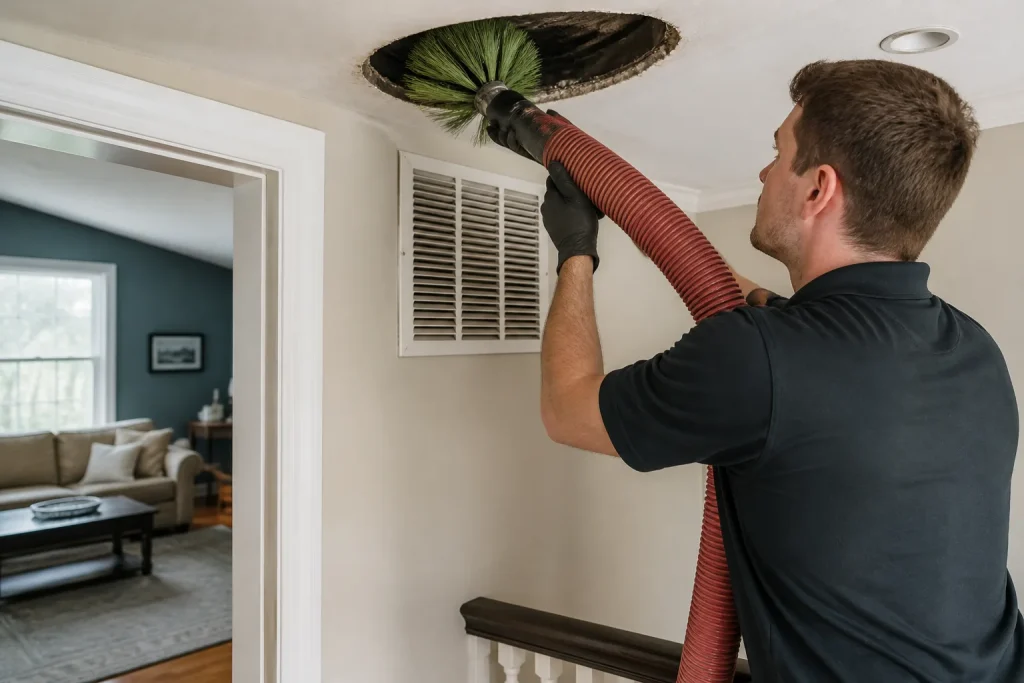
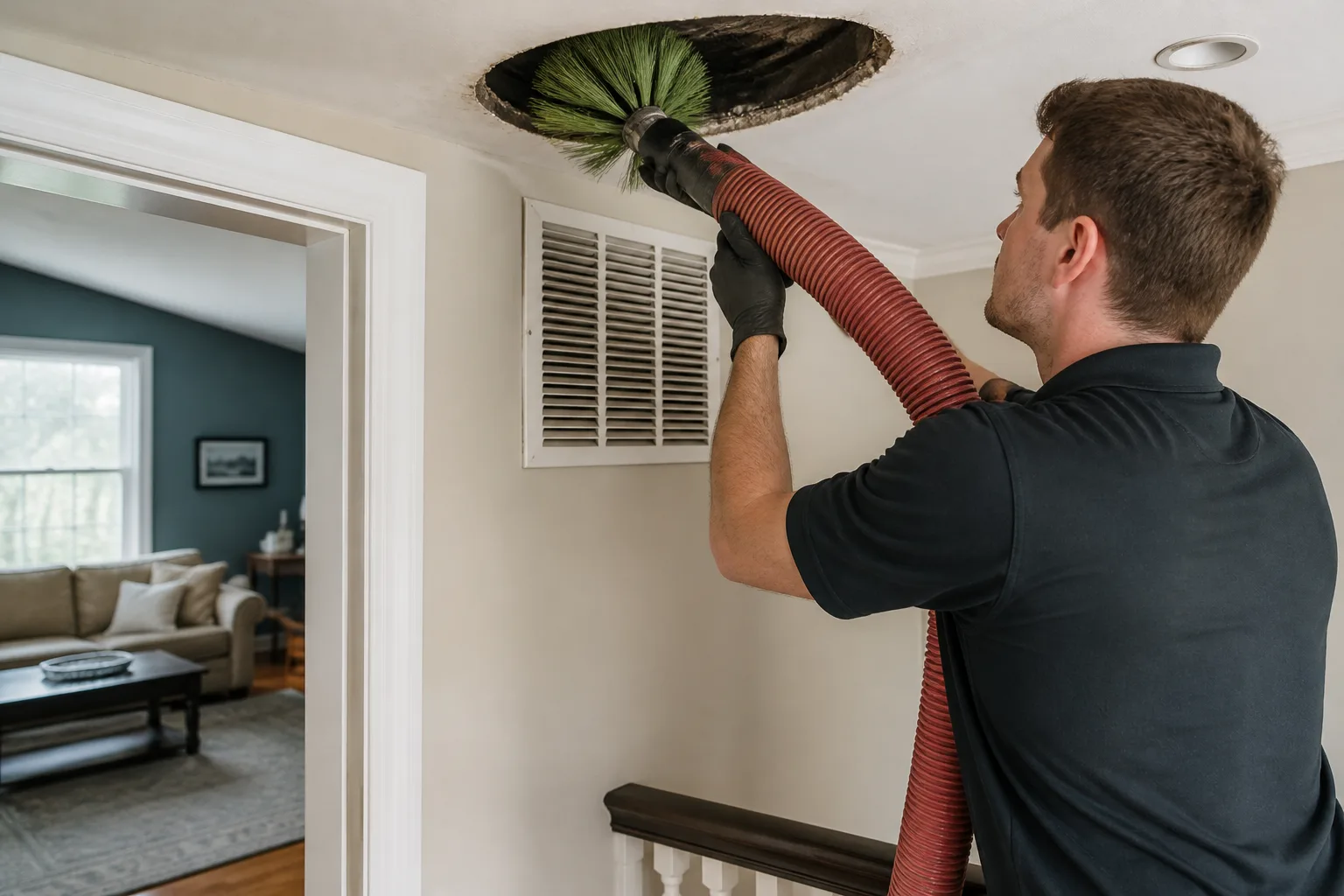
- “Are you agitating the duct interior, or just vacuuming the accessible sections?” A rotary brush system such as Rotobrush reaches duct walls that a vacuum alone won’t lift debris from.
- “What’s your process for confirming the source is gone?” A real answer describes verification, not just a promise.
If a quote is much cheaper than the others and the answer to all four questions is vague, the price usually reflects what’s missing from the job, not a bargain.
The Documentation That Speeds Up Diagnosis
When a technician walks into a Port Richmond home with photos and a timeline already in hand, diagnosis takes minutes instead of an hour. You’re not doing the technician’s job for them; you’re giving them the history they can’t reconstruct on arrival.
Capture these before the crew gets there:
- Photos of every register and return, plus the air handler and filter, shot with the light on so detail shows.
- An odor timeline. When did you first notice it? Does it get worse when the heat or AC runs? Does it fade when the system is off?
- Recent HVAC events. A filter change, a repair, a blower replacement, a water leak, a pest treatment. Anything that happened in the last six months is relevant.
- A short video of the system running, so the technician can hear unusual sounds before they arrive.
Save it all to your phone and share it when you call. We’ve found that a homeowner who can answer “when did this start” precisely gets a faster, more accurate assessment than one who’s guessing.
When Cleaning Alone Won’t Fix It
Sometimes the ductwork isn’t the problem; it’s the symptom. If the source is active mold growth fed by a moisture issue, cleaning the ducts without fixing the water source means the growth returns. If the return is undersized or a supply run has come apart in the attic, no amount of cleaning restores the airflow. Duct repair and sealing comes before cleaning in those cases, and sometimes remediation does too.
We look for leaks at every joint, seal them, and confirm the seal before moving on. That diagnostic step is one most cleaning-only companies skip, and it’s the difference between a system that’s clean and a system that actually works.
When to call a pro: if you’ve shut the system down, changed the filter, and the odor or visible dust is still there, it’s time. Related services in Port Richmond: we handle air duct cleaning and dryer vent cleaning, and our HVAC cleaning covers the air handler and coil. The full picture of what we do lives on our Air Duct Cleaning Port Richmond page.
The Bottom Line
The first call in a duct emergency shouldn’t be to a cleaner. It should be to your thermostat, to shut the system down. Once that’s done, rule out the filter and the obvious maintenance backlog, document what you’re seeing, and then decide whether the situation is a true hazard (water, fire, mold, vermin) or a job that can be scheduled like any other.
If it’s a real emergency, the questions you ask before booking matter as much as the price. HEPA vacuum, containment, rotary agitation, and a plan for confirming the source is gone.
If you’re in Port Richmond and need help, Air Duct Cleaning Port Richmond offers free estimates. Call (877) 792-6601. We answer 24/7. Fast dispatch from 7am to 7pm, Sunday through Friday. Our technicians have up to 14 years of experience, and we work with Honeywell and Aprilaire filtration products when the cleaning is done and you want to keep the air clean going forward.
Frequently Asked Questions
It depends on the size of the system, the number of runs, and whether containment or sanitizing is needed, so we price each job from a written estimate rather than a flat rate. If you’ve got an urgent situation, call (877) 792-6601 for an exact quote. Estimates are free.
No, and please don’t. If the source is mold, vermin, or fire residue, running the system distributes it through every room. Shut the air handler down first, then call.
Cheap quotes usually reflect what’s missing: no HEPA vacuum, no containment, no rotary agitation, just a vacuum run over the accessible sections. On an emergency job, that gap is exactly where the hazard lives. Call (877) 792-6601 for a quote that spells out the equipment and the process.
For most Port Richmond homes, every few years is reasonable, sooner if you’ve had water intrusion, a renovation, or pets. It’s not an annual must-do, despite what some marketing suggests. Call (877) 792-6601 for an honest assessment of whether your system actually needs it.
Written by the team at Air Duct Cleaning Port Richmond.
Need Air Duct Cleaning Help?
Call Air Duct Cleaning Port Richmond - the local pro we connect you with is licensed and insured, here with fast help in Port Richmond.
(877) 792-6601