
Rotobrush Air Duct Cleaning in Port Richmond: A Homeowner’s Guide
Most duct cleaning complaints start with the same observation: the debris didn’t leave, it just moved. That’s what happens when a crew agitates dust with one pass and vacuums with another – the material is airborne before the collection catches up, and some of it settles back into the system or into your rooms. Rotobrush works differently. It agitates and vacuums at the same point, at the same moment. That mechanical distinction is the whole point of this guide, and it’s why we think Port Richmond homeowners deserve to understand it before they book anything.
What Makes Rotobrush Different From Other Duct Cleaning Methods?
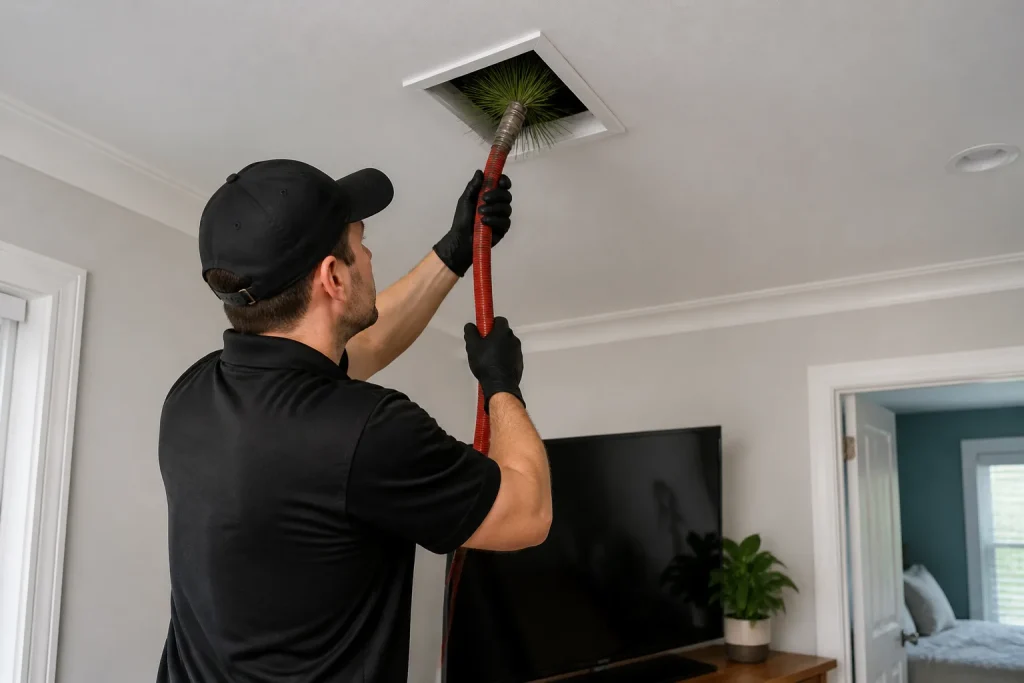
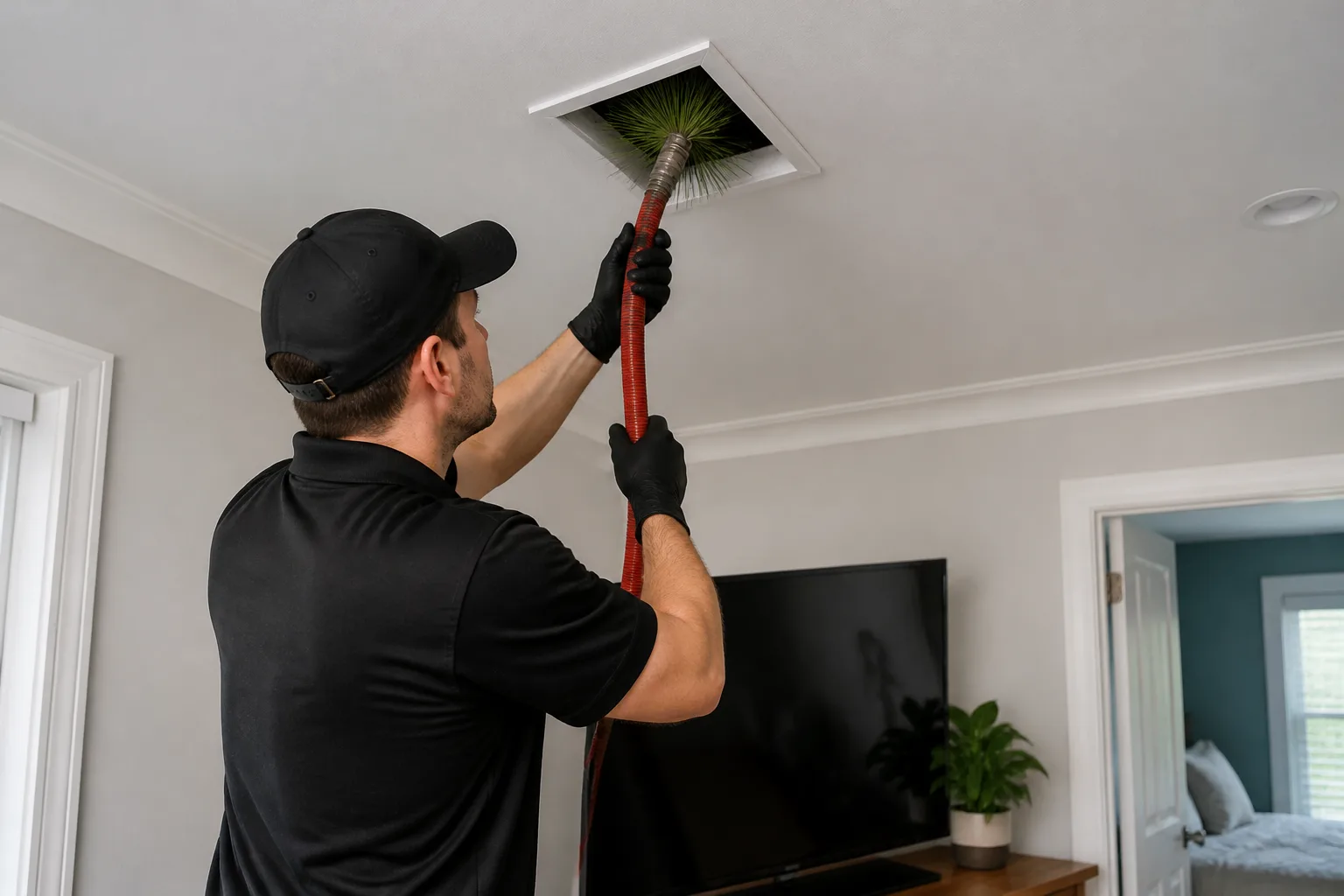
Rotobrush is a rotary brush system with an integrated vacuum hose that runs alongside the brush head. As the brush loosens debris from the duct wall, the vacuum captures it at that exact spot before it has a chance to travel. The alternative – sequential methods – agitates first and sweeps downstream second. Between those two phases, dust becomes airborne inside your ductwork and drifts wherever pressure sends it.
Here’s the practical breakdown of the difference:
- Simultaneous extraction: The Rotobrush head carries its own vacuum pickup right at the brush. Debris is captured at the point of agitation, not chased down the line afterward.
- Sequential agitate-then-sweep: Debris is loosened first, then swept toward a downstream vacuum. In open, straight duct runs this works reasonably well. In branching layouts, debris can drift into side branches that the sweep never reaches.
- The containment question: Any source-removal method needs proper containment to be honest about where debris goes. That’s why we pair Rotobrush with Abatement Technologies containment equipment – negative pressure that keeps the work area sealed while cleaning happens.
- What the vacuum alone does: Consumer-level shop-vac setups pull surface dust. They don’t mechanically agitate caked material from duct walls, so a layer stays behind.
We’re not suggesting every duct cleaning company that doesn’t use Rotobrush is cutting corners. Some carefully run sequential jobs on simple, straight systems do fine work. The distinction matters most when the duct layout is complicated, and that’s exactly where Port Richmond homes tend to land.
Why Port Richmond Duct Layouts Suit Rotobrush Cleaning
Port Richmond’s row houses and multi-family conversions were built with duct systems that branch in ways modern tract homes don’t. A trunk line splits into multiple runs that fan out to individual rooms, and in converted buildings those branches often take unexpected turns – around original structural walls, through spaces that were added later, sometimes around corners that weren’t designed with airflow in mind. Establishing a clean vacuum path through that geometry is genuinely difficult.
That layout is where the Rotobrush design earns its place. Because the vacuum pickup is attached to the brush, the technician only needs access to a branch entry point. The tool works within the branch, not depending on a full-length vacuum run established from a single collection point. In practical terms:
- Branching row house systems: The brush head can work each branch independently without requiring a downstream vacuum to be pulled through every turn.
- Multi-family conversions: Duct runs that share space with later structural changes can be cleaned run by run rather than relying on an overall pressure system that the layout resists.
- Short runs with limited access: Access points may be fewer than a sequential method needs. Rotobrush can enter, agitate, extract, and exit at the same point.
- Tighter crawl and basement spaces: The equipment is compact enough to work from a nearby access without needing to thread hoses through multiple points simultaneously.
A rotary brush isn’t magic, and it can’t reach a duct that has no access at all. What it does is make a realistic cleaning possible on layouts where the alternative is agitating dust into places nobody can reach.
Which Duct Materials Can Rotobrush Clean Safely?
Rotobrush performs best on sheet metal ductwork – the rigid, galvanized type common in older Port Richmond homes. The brush can agitate the metal surface thoroughly, and hard duct walls respond well to rotary action. Flexible duct is more complicated. The wire helix and thin liner inside a flex run can be damaged by a brush spinning at the wrong speed, and liner separation is a real risk if a technician isn’t paying attention.
Ductboard, the rigid insulated material used in some later construction, is softer than metal. Brush speed and pressure need to be reduced, and a technician needs to know where seams and taped joints are located before pushing a brush through them.
What this means for you:
- Ask what material your ducts are made of before the crew arrives. A technician who doesn’t ask is a technician who may damage the system.
- Flexible duct in a Port Richmond home should get a conversation, not a default brush pass. Ask how speed will be adjusted.
- If your ducts are sheet metal and the technician confirms it on site, rotary brushing at full agitation is the appropriate method.
- Any technician who can’t tell you which brush speed and pressure they’ll use for your specific duct material hasn’t thought about the job carefully enough.
Our technicians have up to 14 years of experience with rotary systems and they evaluate duct material on arrival. That isn’t a sales pitch – it’s a job requirement. A brush that rips a flex liner leaves a system that needs repair, and that’s a worse outcome than not having cleaned it at all.
What Should a Complete Rotobrush Service Run Cover?
A thorough Rotobrush session isn’t a single pass through one duct. It’s a systematic run that covers supply branches, the main trunk, the air handler interior, and the return path. How long that takes depends on system size, number of branches, and how heavily soiled the system is. For a typical Port Richmond row house with a medium-complexity layout, a complete cleaning should reach every accessible branch – not just the easiest ones to get to from the basement.
Linear footage per session varies by home, but a rough orientation point: most residential duct systems in this market run somewhere in the range of 40 to 100 linear feet of ductwork per zone, and a complete job reaches all of it. If a company can’t tell you which branches they plan to clean before they start, the answer is usually “the ones they could reach easily.”
A complete run should include:
- Every supply branch from the main trunk to the register boot, as far as access allows
- The supply trunk itself, with mechanical agitation and vacuum extraction
- The return air ducts and any central return plenum
- The air handler cabinet and blower compartment interior, coordinated with your HVAC cleaning provider or covered under HVAC cleaning as part of the same visit
- Verification that no supply register was skipped due to access problems without documenting it
Consistent flow through every branch is part of the cleaning itself. A crew that cleans nine of eleven registers and moves on has left a weak link. When air quality products are being installed after cleaning – Honeywell or Aprilaire filtration and humidity control are the two we regularly see recommended – the duct system needs to be clean first or the new hardware is filtering dirty air.
How Do You Verify the Job Was Done Correctly?
Ask for post-cleaning airflow checks and a visual walk-through, and look at what the crew actually brought out of the duct. A good verification process gives you something to see and something to measure. The industry has enough stories about crews spending forty-five minutes in a home and calling it a full cleaning, and the only way to tell those jobs from a real one is to check before the crew leaves.
A few concrete things to do:
- Walk the registers yourself before and after. A register face that’s been cleaned should show the same or less dust than it did an hour prior. If you can see dust settling in a supply boot, ask the crew to look again.
- Ask for the debris capture bag. A properly cleaned system returns a bag of material to the containment setup. Rotobrush and Nikro HEPA-filtered systems both collect what comes out. A crew with nothing to show may not have pulled anything.
- Ask for a before-and-after photo of the same register or trunk interior. A phone photo of the supply plenum before and after cleaning is a direct record of what the job actually produced. We provide those to the homeowner as part of the service.
- Have airflow from a few registers noted before and after. A simple manometer reading or a hand-check of air movement at each register can show whether the cleaning changed flow or restricted it.
- Note the return air grille. If a return had heavy lint before cleaning and the same lint after, the return likely wasn’t covered.
If a crew finishes before you’ve had a chance to walk through with them, ask them to do it anyway. A professional crew won’t be bothered by the request. It’s the answer that matters.
When Should You Call a Pro Instead of Cleaning Ducts Yourself?
Duct cleaning sits in a category where the equipment gap is unusually wide. Consumer tools, including shop vacuums and brush kits sold for household use, pull surface dust from registers but can’t remove caked material from duct walls, can’t capture debris at the agitation point, and can’t run proper containment. And once you’ve pushed a brush into a branch without a vacuum picking up at the brush head, the dust you loosened is now circulating through the house.
Call a professional when:
- Airflow at registers feels noticeably weaker than it should be, and filter changes haven’t fixed it
- Any supply or return register shows visible dust, lint, or darkening on the boot interior
- There’s a musty or stale smell when the HVAC comes on
- You’re putting a new or replacement Honeywell, Aprilaire, or similar air quality product into service – install after cleaning, not before
- You’ve noticed dust settling on furnishings faster than usual
- Your duct system has a repair need – a disconnected joint, a leak at a register boot, or a liner that’s separated
If you’re in Port Richmond and any of those ring true, or if you want a dryer vent checked while the crew is on site, ask about dryer vent cleaning on the same visit. Dryer vent lint buildup is a different hazard entirely – lint is a real fire risk and a blocked exhaust is worth confirming rather than assuming – and it’s cleaner to handle it in one scheduled visit than two.
Related services in Port Richmond: If you only need a single service – a duct cleaning run without the full pathway scope – an air duct cleaning quote is the right starting point. Homeowners who want the full indoor air pathway addressed in one relationship often combine duct cleaning, dryer vent clearing, HVAC cleaning, duct repair and sealing, and air sanitizing under one service. Reaching the full scope through a single provider avoids the finger-pointing that happens when multiple contractors touch the same system.
One last note on the tool side: Guardsman-line protective treatments are available within the sanitizing tier when organic buildup is a concern. They’re applied after cleaning, not instead of it, and they’re a separate step from the mechanical work. If a company offers sanitizing as a substitute for cleaning, that’s the wrong sequence.
The Bottom Line
Rotobrush earns its reputation through mechanics, not marketing. Simultaneous agitation and extraction changes where debris ends up during cleaning, and that difference matters most in branching row house and conversion layouts where a standard vacuum run is hard to establish. If you live in Port Richmond and your ducts are sheet metal, well-sealed, and connected to a system that hasn’t been cleaned in years, the Rotobrush method is worth asking specifically about before you book. Ask what brush speed will be used for your duct material, request a before-and-after photo of a register or trunk interior, walk the registers with the crew at the end, and expect the answer to be specific. Written estimates stand at one flat price per system, agreed before work starts, with photos of your own ducts as the closing document. If you’re in Port Richmond and need help, Air Duct Cleaning Port Richmond offers free estimates – call (877) 792-6601. We answer 24/7, and fast dispatch runs 7am to 7pm, Sunday through Friday. For a broader overview of what we do, see the main air duct cleaning Port Richmond page.
We answer 24/7. Fast dispatch from 7am to 7pm, Sunday through Friday. Call (877) 792-6601.
Frequently Asked Questions
Whether Rotobrush is worth the difference depends on your duct layout. In a simple, mostly straight duct system, a careful cleaning with a proper containment vacuum can work. In branching row house or converted multi-family layouts common to Port Richmond, the ability to agitate and vacuum at the same point makes a real difference in where debris ends up. The question to ask a cheaper alternative isn’t “why are they cheaper” – it’s “where does the dust go when the brush loosens it?” Call (877) 792-6601 and we’ll walk you through how our Rotobrush setup would handle your specific system. Estimates are free.
Not if it’s used correctly. The brush can damage a flex liner if speed and pressure aren’t adjusted for the softer material. A technician should evaluate duct material on arrival and dial back the brush setting for flex or ductboard. If a crew can’t tell you what material your ducts are made of before they run a brush through, that’s a warning sign. Ask before they start. Our technicians have up to 14 years of experience with these systems and treat material evaluation as step one. For a free estimate on a Port Richmond system, call (877) 792-6601.
A complete run covering all supply branches, the return path, and the air handler interior usually takes longer than a single-pass job because it actually covers everything. The exact time depends on system size, number of branches, and how heavily soiled the ducts are. A reduced time can mean work wasn’t covered – not that the crew is efficient. Ask before the job starts which branches and returns will be cleaned, then walk the registers with the crew at the end. Call (877) 792-6601 to schedule a free estimate.
There’s no universal timetable, and any company that gives you one without looking at your system is guessing. Common triggers include visible dust on registers, musty odor, recent renovation or water intrusion, noticeable airflow loss, and moving into a home with unknown maintenance history. For many Port Richmond homes, several years between cleanings is normal if filters are changed regularly. If something has recently happened – a renovation, a moisture event, a new HVAC install – an earlier cleaning makes sense. Call (877) 792-6601 for a free estimate and we’ll tell you honestly whether cleaning is worthwhile now.
Written by the team at Air Duct Cleaning Port Richmond.
Need Air Duct Cleaning Help?
Call Air Duct Cleaning Port Richmond - the local pro we connect you with is licensed and insured, here with fast help in Port Richmond.
(877) 792-6601